

This post was originally published by Databricks.
Most healthcare data teams spend months building and maintaining pipelines to move data from EHR systems into their analytics environment. Even after that work is done, data is often routed through intermediary storage layers before it can be processed, introducing latency that limits real-time use cases.
The result is a system that is complex to maintain and too slow to act on.
Databricks and Redox have teamed up to change this model, removing two core barriers:
- The complexity of building healthcare data integrations
- The latency of getting data into the analytics environment
Now, teams can stand up real-time clinical data pipelines using natural language prompts directly within Databricks, simplifying how data is accessed and activated.
TL;DR: Databricks and Redox enable healthcare teams to build real-time clinical data pipelines using natural language, stream data into cloud environments with subsecond latency, and write AI outputs back into the EHR to drive action at the point of care.
The problem: AI strategy is bottlenecked by integration + latency
Healthcare organizations are under pressure to operationalize AI, but execution consistently bottlenecks at clinical data integration.
Before any models or workflows can be deployed, teams must integrate with EHR systems, normalize formats like HL7, CCD, and X12, and build ETL pipelines. This work is time-intensive and requires specialized expertise.
Even after pipelines are in place, data often flows through intermediary storage layers before reaching Databricks, adding latency and operational overhead. What is labeled “real-time” becomes delayed, and engineering teams remain focused on infrastructure instead of delivering insights.
As a result, AI initiatives stall and time-to-insight stretches from weeks into months.
A new approach
Databricks’ Zerobus Ingest and the Redox MCP Server introduce a different approach for building and operating clinical data pipelines in Databricks.
The Redox MCP Server allows teams to build and manage integrations using natural language, reducing the time and complexity involved in building new data pipelines. Zerobus streams clinical data directly into Databricks Unity Catalog managed tables with subsecond latency, removing the need for intermediary storage layers or workflows to load the files for processing.
Together, they change both how pipelines are built and how quickly data becomes usable. Integration is defined through prompts instead of code, and data is available for processing as it is generated. This means teams can connect to EHR systems, stream clinical data, and activate workflows directly within Databricks.
What This Looks Like in Practice
Inside the Databricks platform, a user connects to the Redox MCP Server and begins with a prompt. Within a few interactions:
- The system identifies available environments and datasets
- Suggests next steps to complete the workflow
- Executes integration tasks across systems
- Surfaces validation signals like logs and performance summaries
Behind the scenes, Zerobus handles the direct delivery of streaming data into Databricks, eliminating the need for staging layers or batch ingestion. This allows each step of the workflow to operate on live data as it arrives.
In one example, the system retrieved a recent patient admission and returned both structured data and a plain-language summary. Complex clinical data became immediately usable for downstream analytics and decisioning.
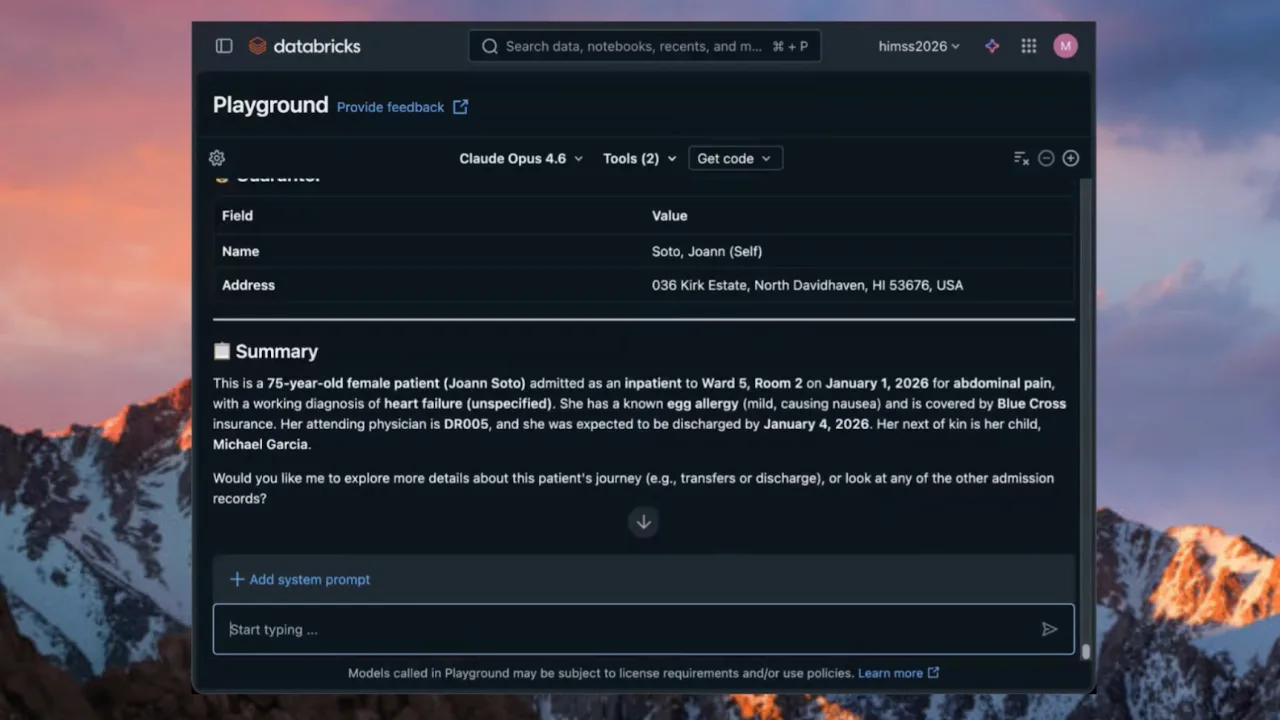
Figure 1. The system summarized a recent patient admission in plain English.
From months to minutes: Accelerating time-to-insight
What previously required weeks or months of integration work can now be initiated in minutes all using natural language without leaving Databricks.
By eliminating intermediary data landing steps with Zerobus and simplifying pipeline creation through natural language prompting, organizations can dramatically reduce both latency and development time. This enables teams to validate AI use cases faster, shorten development cycles, and move from experimentation to production more quickly.
Integration is no longer the gating factor, and data latency is no longer the limiting constraint.
Reducing dependency on specialized expertise
Healthcare integration has traditionally required deep expertise in HL7, APIs, and data orchestration.
With the Redox MCP Server, much of that complexity is abstracted away. Organizations can reduce their reliance on HL7 experts and integration specialists, enabling broader teams to work with clinical data.
Data scientists and ML engineers can focus on building models and generating insights instead of managing ETL pipelines. Engineering teams can shift from maintaining integrations to enabling new capabilities.
The focus moves from “how do we get the data” to “how do we use the data.”
Enabling real-time clinical intelligence
With Zerobus, clinical data arrives in Databricks with subsecond latency without intermediate storage layers or batch processing. This allows FHIR to be treated like it was always meant to be treated–as transactional and sent to REST API endpoints. For example, a health plan or provider organization can send prior authorization specific bundles through Redox directly to a dedicated REST API endpoint where it needs to be in Databricks instead of landing in a FHIR Store or as a substantiated FHIR JSON file first.
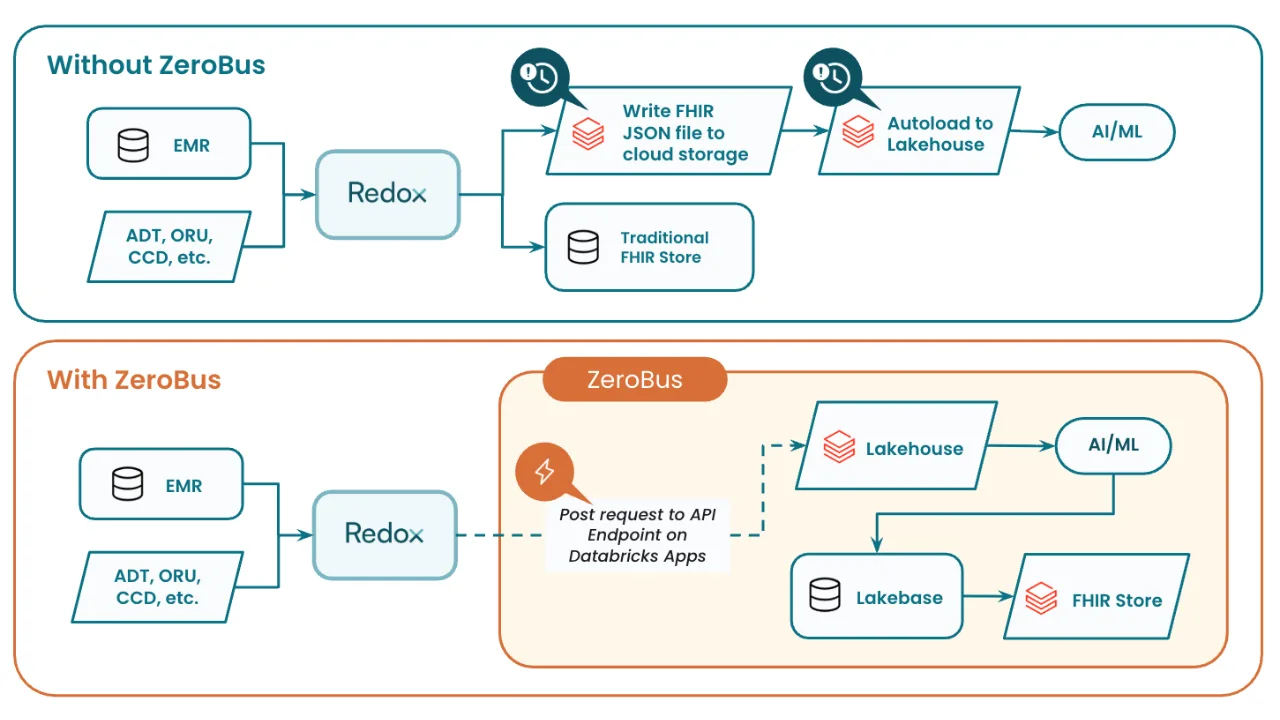
This allows ML and AI Agent frameworks to process prior authorization requests and responses instantly. By bypassing the need for additional data pulls or the complex ETL required to parse raw FHIR JSON files, these systems can capture and act on the patient journey as it unfolds, not after the fact.
Paired with Redox EHR writeback capabilities, these insights can be operationalized directly within clinical workflows. AI-generated outputs can be written back into the EHR in real time, closing the loop between data, intelligence, and action at the point of care. This shifts Databricks beyond a system of analytics into an application layer for healthcare operations, where data pipelines and AI models do not just inform decisions, but actively drive interventions inside core clinical systems.
This unlocks a new class of real-time use cases:
Track patient state in real time
Continuously update admissions, transfers, discharges, and clinical events as they happen
Optimize capacity as conditions change
Use live patient movement and census signals to improve bed management, staffing, and throughput
Trigger interventions at the right moment
Engage patients, care teams, or systems based on live clinical signals rather than delayed reports
Detect risk as it emerges
Identify deterioration, gaps in care, or operational bottlenecks while there is still time to respond
Adapt discharge and care pathways dynamically
Adjust next steps based on current patient status rather than static snapshots
Synchronize clinical and financial workflows
Capture events as they occur to improve coding, billing, and revenue cycle accuracy
Now, healthcare organizations can operate with greater agility and responsiveness, aligning their data workflows with the pace of patient care delivery.
Why this works: A trusted foundation AI can act on
This capability depends on a reliable, standardized clinical data foundation. Redox provides the standardized layer for exchanging healthcare data across EHRs and other downstream systems through a single platform and API.
Zerobus ensures that this data arrives in Databricks without delay. The Redox MCP Server makes that data accessible and actionable through natural language by translating intent into execution while enforcing enterprise-grade security, compliance, and operational controls.
Together, they create a real-time execution layer for clinical data and AI workflows.
Beyond pipelines: Building the “Redox Agent”
And we’re not stopping at data ingestion. Because the Redox MCP server sits alongside Databricks Genie Spaces on top of the clinical data, AI teams can now build Redox Agents on Databricks.
These specialized agents are capable of:
- Reviewing Redox platform logs to troubleshoot or audit data flows in real-time.
- Answering questions about the clinical data sent by Redox using natural language.
- Embedding intelligence directly into clinical applications while maintaining the strict governance, security, and traceability that enterprise healthcare requires.
By combining the power of the Redox MCP and Genie, teams can move from simply moving data to creating conversational, intelligent interfaces that sit right inside the provider’s existing workflow.
See it in action
In a webinar from Redox and Databricks we showed how Zerobus and the MCP Server work together to deliver real-time data pipelines inside Databricks. See how teams can move from intent to execution using natural language, while operating on live data with subsecond latency.
Watch here to explore how this approach applies to your organization.
This post was co-written by Tim Kessler (Field Chief Technology Officer at Redox), Matt Giglia (Forward Deployed Engineer for Healthcare & Life Sciences at Databricks), and Assunta Carey-Saylor (Senior Product Marketing at Redox).