

Patient data is finally moving at a nationwide scale, but as the volume turns from a trickle into a firehose, everyone is suddenly reading the fine print. It’s all “innovation and disruption” until a network oversight body asks to see your audit logs.
Right in the center of this conversation is onramping. It’s not flashy, but it’s the foundational work that prevents the entire ecosystem from grinding to a halt over trust and security issues.
Onramps as the gateway to national networks
In healthcare, onramping is the technical, legal, and clinical vetting required to join a data-sharing ecosystem like Carequality or TEFCA. Think of it as a pre-expedition gear check: you can’t show up at the trailhead in flip-flops and hope for the best. You have to prove you’re prepared and promise to follow the rules of the trail so you don’t put the rest of the group at risk.
Critically, this isn’t a solo trek. While there are several Qualified Health Information Networks (QHINs) that serve as the highways for data, getting yourself access to those highways is a specialized lift. You essentially have two choices:
- Connect directly to a QHIN: This is a viable path for large organizations with the massive legal and technical resources to manage 400-page framework agreements and bespoke configurations on their own.
- Partner with an Onramp: While a QHIN provides the highway, a partner like Redox acts as your Sherpa to handle the heavy lifting. We manage the technical wiring, legal vetting, and specialized credentialing so you can focus on the summit rather than the paperwork.
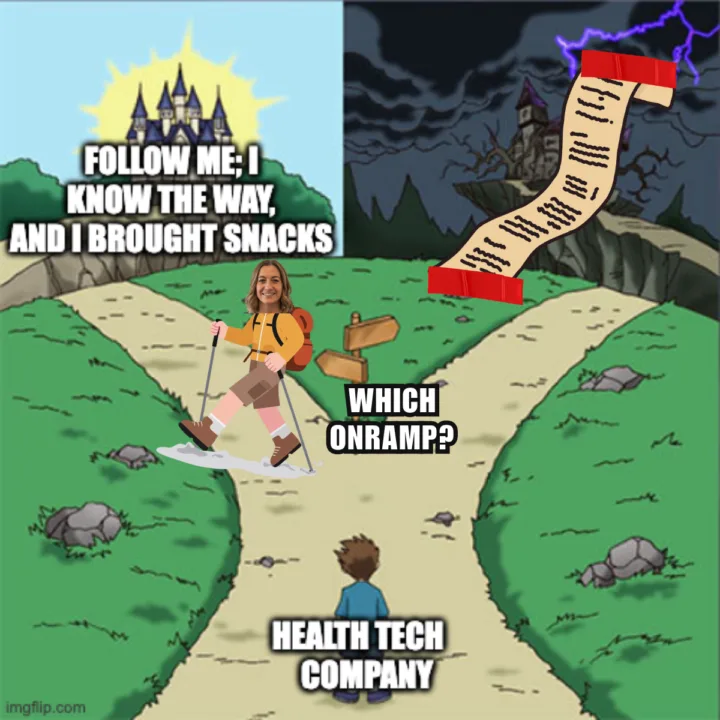
By intentionally choosing not to be a QHIN ourselves, we stay out of the political fray and remain an unbiased advocate for your strategy. It’s the difference between staring at a long application in a foreign language and having a guide say, “Follow me; I know the way, and I brought snacks.”
Just because you can, doesn’t mean you should
This rigor exists because the stakes of data access have shifted. Most of the recent market instability boils down to one question: Who is accessing patient data, and why?
Purpose of Use (POU) is not a terms-and-conditions checkbox you can scroll past. When the “why” gets fuzzy, network connections are put under a microscope and legal teams suddenly become the most popular people in the office.
When you democratize access to sensitive info, you scale the need for absolute clarity. Without it, trust (the very currency of interoperability) devalues overnight.
Closing the integrity gap
Healthcare interoperability shouldn’t operate as a “set it and forget it” gamble. High-velocity data exchange requires intentionality from day one (trust us, winging it is not a strategy that scales well).
This integrity-first approach to network onramps to Carequality and TEFCA centers on four pillars:
1. Vetting that goes beyond vibes
Integrity starts with ensuring every participant is exactly who they say they are and has a verifiable, permitted reason to access the network. Credentials must be rock-solid, not just good enough to talk your way past a gatekeeper.
What this looks like in practice: Instead of just accepting a digital signature, a partner should be validating organizational NPIs, verifying clinical licensure, and ensuring the entity has a physical presence and a verifiable track record of providing care. An expert guide ensures your pack is correctly weighted and your permits are in order before you even reach the trailhead, preventing technical or legal rejections that could stall your journey.
2. POU guardrails (because “Treatment” isn’t a catch-all)
The Treatment Purpose of Use is a powerful tool, but it’s not a magic wand you can wave over every data request. A strong onramp partner should have built-in guardrails to ensure requests align with network expectations, saving you from those awkward we need to talk emails from oversight bodies that tend to ruin a perfectly good Friday afternoon.
What this looks like in practice: A strong partner provides active oversight rather than just passive connectivity. They use technical logic to validate a user’s role against their stated Purpose of Use before the request hits the network.
Beyond the technology, a leading partner sits at the table with national advisory groups and framework implementer communities to help shape the rules. This ensures your data strategy is informed by real-time policy shifts, keeping you ahead of the compliance curve and ensuring every query is appropriate.
3. Audit readiness that isn’t a fire drill
If a regulator or a partner asks how data is moving, “I think Dave has that spreadsheet” isn’t an answer. Transparent logging ensures that when the questions come (and they always do), the answers are already organized.
What this looks like in practice: A strong partner provides centralized logging for all queries made to networks. Instead of scrambling to reconstruct history, you have a clear record of the “who, what, and why” for every exchange, including timestamps, user IDs, and clinical justifications.
4. Economic integrity (because more data isn’t always better)
Data integrity isn’t just about security; it’s about being a responsible steward of the network and your own budget. High-velocity exchange shouldn’t mean high-waste consumption. A partner who simply opens the gate without guidance leaves you vulnerable to the high costs and noise of an unoptimized data firehose.
What this looks like in practice: A strategic partner acts as a coach, helping you refine your query logic to match your actual clinical requirements. Instead of broad, expensive requests, you implement targeted discovery that limits volume to only what’s necessary. This intentionality ensures that retrieving data remains affordable, efficient, and sustainable as you scale.
Network data is only the beginning
A truth that often gets lost in the hype is that national networks are rarely a complete data strategy. While they offer incredible scale for pulling history, they don’t always provide the specific data types or functional depth that a high-impact digital health product requires.
Most national networks are built for read-only visibility. They’re great for broad discovery, but if your application needs to do more than just observe (think inserting a discrete lab result, updating a care plan, or triggering a clinical task) a network connection often hits a wall. To truly move the needle for a clinician, your tool has to live inside the workflow, not just next to it.
If your product relies on high-frequency, real-time data or the ability to write back into very specific EHR fields, a 1:1 integration is often the better option. While networks cast a wide net for information, direct connections provide the write access and precision that high-acuity tools depend on to be effective.
The most successful teams build on a foundation that doesn’t force them to choose. You can start with a national onramp for broad scale today, while maintaining the flexibility to deploy 1:1 bidirectional EHR integrations where you need more precision. An abstraction layer ensures your infrastructure can flex as your data needs evolve.
Scaling with integrity at any stage
We believe that a high bar for data integrity should be the industry standard, not an expensive barrier to entry. Every health tech team deserves a partner that treats their data strategy with enterprise-level seriousness from the very first connection.
Think of a solid onramp as the ultimate “little treat” for your future self: a version of you that gets to spend Friday afternoons actually finishing work instead of answering audit queries. In this industry, boring is the highest compliment we can give: it means things are working exactly the way they should.
To support this, the barrier to entry for early-stage teams must remain low without compromising on security. Health tech startups can now connect to networks via Redox for as little as $10k per year.
The companies that lead the next era of healthcare won’t just be the ones that connect the fastest; they will be the ones that build on a foundation of trust, backed by a partner who has already mapped the route and can guide them through every turn.
Ready to build on a stable foundation? Explore the Redox approach to networks like Carequality and TEFCA.
This post was written by Jenn Kavanaugh, VP of Customer Success, Vendor Markets at Redox.