

For health systems operating on razor-thin margins, the traditional response to rising document volumes is a financial trap: adding more headcount to handle the paperwork.
Every incoming document has a next step. A fax needs classification. A referral requires routing. Multiply that across thousands of pages a day, and your operational efficiency becomes entirely tethered to a growing, expensive payroll.
This model is breaking under financial pressure. Industry data shows that 52% of faxes still require manual staff intervention before any action can be taken, and 88% of hospital administrators report that these manual fax delays directly impact patient care.¹ Plus, with nearly half of all inbound documents flagged as time-sensitive, manual triage directly leaks revenue.
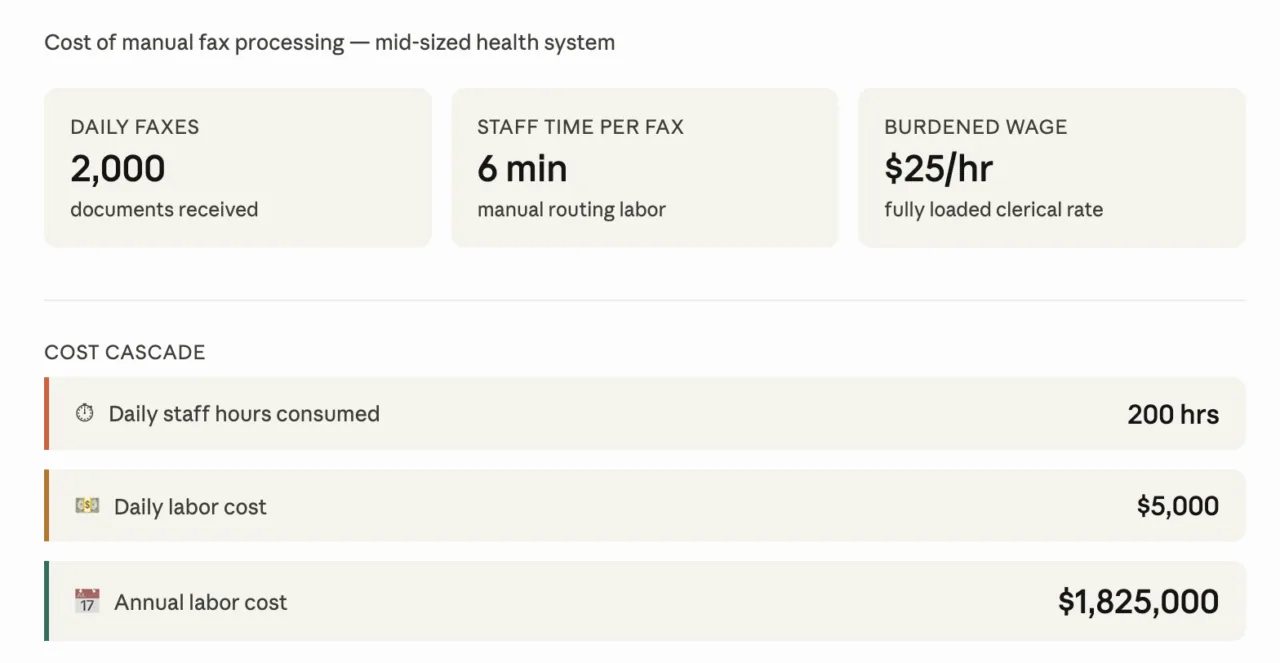
Consider a mid-sized health system receiving a modest 2,000 faxes per day. At an average of 6 minutes of manual labor per document, that represents 200 hours of staff time consumed every single day just reading and moving paper. At an average fully burdened clerical wage of $25/hour, that is $5,000 a day—or $1.8 million annually—spent strictly on human routing switches.
The solution: Speed to value in 35 days
Instead of paying staff to manually sort documents, intelligent routing automatically classifies documents, extracts critical information, and sends them to the correct downstream destination whether that be a folder, workflow, or queue. This allows staff to shift from manual triaging to exception handling.
The ROI isn’t a multi-year road map. Redox recently went live with automated fax intake and routing for a large regional health system in just 35 days. In addition to reducing expected headcount by 59%, the health system has now automatically routed over 1.5M faxes and reduced the average document processing time from 8-10 hours to 1-2 minutes.
This same capability can be deployed across these six high-overhead cost centers to protect your bottom line:
1. Referral intake: Eliminating revenue leakage
Referrals are critical for volume, but their manual processing is a massive cost drain. Packets arrive via fax, email, and portals, forcing staff to read each one, determine urgency, find the right provider, and manually attach it to a chart. Pages go missing, providers get frustrated, and patients leak to competitors.
The automation transformation: Automated classification identifies the referral instantly, extracts key patient data, and queues it for scheduling without a human touching it. Now when document volume spikes, your software scales and your staffing costs don’t.
2. Prior authorization: Halting admin burn rate
Prior authorization is already an intensive manual workflow; the sheer volume of incoming clinical notes, labs, and imaging reports makes it worse. Staff waste hours assembling packets and chasing statuses.
The automation transformation: Inbound authorization documentation is automatically classified and routed straight to the designated utilization management team. Reviewers spend their hours actually reviewing, accelerating time-to-decision and reducing the write-offs associated with authorization delays.
3. Medical records and HIM: Cutting manual triage hours
HIM teams are buried under an erratic mix of external consultation notes, operative reports, and discharge summaries. Clinics report that 61% of these faxes are still reviewed manually, resulting in constant backlogs and delayed clinical access.
The automation transformation: The system instantly recognizes the document type and files it to the correct section of the patient chart or departmental workflow upon arrival. This eliminates indexing backlogs and frees skilled HIM specialists from low-value data entry.
4. Revenue cycle workflows: Protecting cash flow from deadlines
Revenue cycle performance hinges on how quickly payer correspondence is processed. Denials, appeals, and information requests sit in central fax queues, aging against strict payer deadlines. Hospitals experience nearly twice as many fax-related claim delays as other facility types.
The automation transformation: Incoming payer communications are instantly sorted by claim or denial type and dropped into the precise financial work queue. Faster assignment means meeting tight appeal windows, slashing write-offs, and accelerating cash flow.
5. Patient registration: Streamlining patient access
Patient access teams spend hours manually sorting a chaotic influx of insurance cards, IDs, and consent forms sent across multiple channels, acting as expensive middlemen just to route documents downstream.
The automation transformation: Inbound registration paperwork is automatically directed to its specific endpoint: insurance docs go straight to eligibility verification, while signed consents route directly to the clinical chart. This frees front-end staff to focus on exception handling and direct patient contact.
6. Care coordination: Eliminating costly discharge bottlenecks
Transitions of care depend heavily on fast, accurate paperwork from skilled nursing facilities, home health agencies, and rehab centers. When these time-sensitive documents languish in a general fax inbox, discharge pipelines back up and length-of-stay metrics suffer.
The automation transformation: Transition-of-care documents are identified and delivered to the specific care coordination team the second they are received, preventing costly communication gaps and reducing readmission risks.
The bottom line
When margins are thin, you cannot solve a document problem with headcount. The opportunity to radically lower your operational cost structure starts with the very next fax that your organization receives.
Ready to see how fast your health system can eliminate manual document triaging? Contact Redox today to learn how our intelligent routing solution can go live in weeks, protect your margins, and scale your operations without increasing your headcount.
Sources: