

This post was written by Rachel Witalec, Chief Product Officer at Redox.
Think about how you make online purchases today. When you click “buy” on an order, you don’t log into the warehouse management system, the carrier’s logistics network, or the customs platform. One click sets a dozen systems in motion. The only interface you ever see is an order confirmation and a tracking page, which is a visibility surface, not a workflow tool. The work is completely behind the scenes. The watching stayed visual.
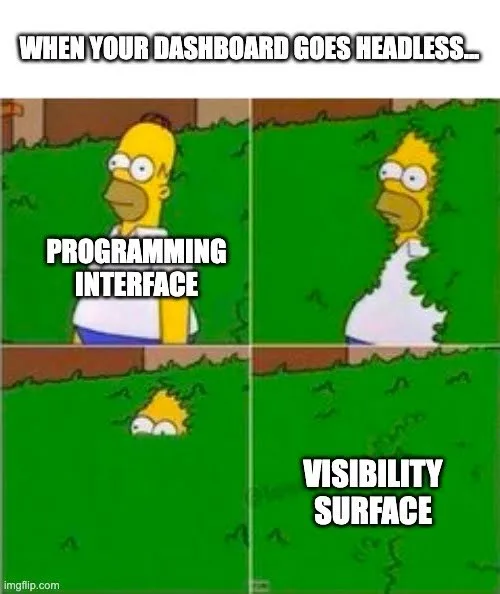
This pattern has a name: headless. The software still does all the work. You just don’t see its face anymore.
Interestingly, headless software access maps almost exactly onto where healthcare data infrastructure is heading. This has real implications for how (and where) you build, what your engineers spend their time on, and the true purpose of your customer dashboard / user interface (UI).
Your most productive team members have already stopped logging in
Something interesting is happening among the most technical users in healthcare IT. They are not starting their day by opening a dozen platforms. They are starting with an AI assistant and reaching out from there. Whether pulling data, triggering actions, or configuring systems, they are doing it through APIs, through natural language, or through whatever interface their organization has standardized on.
When integration engineers can interact with a platform through natural language inside the tools they already live in, the friction collapses. They are not learning a new system. They are applying deep expertise through a faster interface. Mapping, formatting, configuration, validation; it happens in a single, continuous workflow instead of a fragmented series of handoffs across screens and tickets and back-channel Slack threads.
Tasks that used to take two days of fragmented effort now take fifteen minutes.
That is not an exaggeration. That is what we are seeing as users begin to use Redox as an MCP (Model Context Protocol) server within their own tools. MCP is the emerging standard that lets AI tools connect to platforms in a principled, structured way via typed, discoverable capabilities that agents can call reliably. Think of it as giving your AI assistant a set of trained hands, not just a voice.
The most common question we hear from technical users says it all: Why would I open the dashboard when I spend most of my day in my AI client?
Going headless requires being API-first from the start
Here is the catch: not every platform can pull this off.
Going headless requires that your platform was built API-first to begin with. A system that bolted an API onto a user interface (UI) as an afterthought cannot suddenly run headless because too much logic lives in the interface. The dashboard is not a window into the engine; the dashboard IS the engine. And you cannot remove a face that is load-bearing.
Redox took the opposite path. Everything our platform does has always been expressible through a well-structured API. The UI was always a view into the engine, never the engine itself. So when MCP emerged, all we had to do was open the door. The foundation was already there: connectivity to over 12,000 organizations across 30+ types of systems, data quality tooling, orchestration logic, and now agentic capabilities — all expressible through structured, callable tools.
Earlier posts in this series explored how the inter vs. intra distinction shapes AI readiness, and how solving data quality problems in-flight creates a lasting strategic advantage. Headless is the next chapter in that same story. You cannot route a conversation through a platform that was never designed to receive one.

The right interface for the right work
Headless does not mean the dashboard goes away. Anyone telling you their UI is disappearing entirely is skipping a step.
The more useful framing is to split the work by what each interface is actually good at.
Setup and configuration belong in a headless interface. This is precise, repetitive, expertise-driven work. Exactly the type of work that a skilled user wants to do through natural language and APIs rather than clicking through screens. For technical users, MCP is becoming the natural destination for this work. When building new self-service capabilities, building headless-first gets capabilities to market faster and meets engineers where they are already working.
However, headless systems still need their ‘tracking pages.’ Said differently, visibility and monitoring belong in a visual interface. When you need to understand the health of dozens of data flows at a glance, spot an anomaly, or trace where a message went wrong, a conversation is the wrong tool. You want to see it. The dashboard’s purpose is shifting from being a primary workflow tool to being a visualization and monitoring surface. This is a promotion, not a demotion. It also lowers the bar for less-technical team members: the integration manager or business analyst who needs to understand and act on data flows without writing a line of code.
There is also a practical reality worth naming. Running everything through large language models has real costs. Tokens are not free. A manual, visual way of doing things needs to remain, both as the right tool for certain jobs and as the dependable backup when it matters. Infrastructure that only works one way is not infrastructure.
The goal is one roadmap, not two. Customers are directly productive in whichever mode fits the task, without being forced to choose. The foundational work that makes headless possible (e.g. well-structured APIs, clean error infrastructure, consistent data standards) is no-regret work. It needed doing anyway. AI just made it urgent.
The interface is changing. The fundamentals are not.
Healthcare integration work is moving behind the scenes, but the watching stays visual. That’s been true for tracking your online order, and it’s becoming very true for where healthcare data infrastructure is heading.
Every headless system still has its tracking page. In healthcare data, that’s your dashboard. It is no longer a workflow tool, but a visibility surface. Your engineers do the work through natural language and APIs. Your broader team stops guessing and starts seeing.
That’s not two competing investments. That’s one coherent system, finally built for how people actually work.
The software is becoming invisible. The work it does is not.
Rachel Witalec is Chief Product Officer at Redox. Earlier posts in this series: Stop blaming the models: the AI is ready. The data isn’t. and The new AI infrastructure: solving for inter vs. intra.