Skip to content

What is Redox Engine and how does it support EHR system integration?

Redox Engine is the healthcare interoperability platform from Redox. Health tech companies, providers, payers, EHR vendors, and life sciences companies use it to move clinical and administrative data between their own software and the EHRs their customers and partners already run.

Without a platform, every new health system customer is a new integration: a new interface spec, a new security review, a new set of message formats, a new connection to maintain. Teams spend months on connectivity instead of on the product they actually sell.

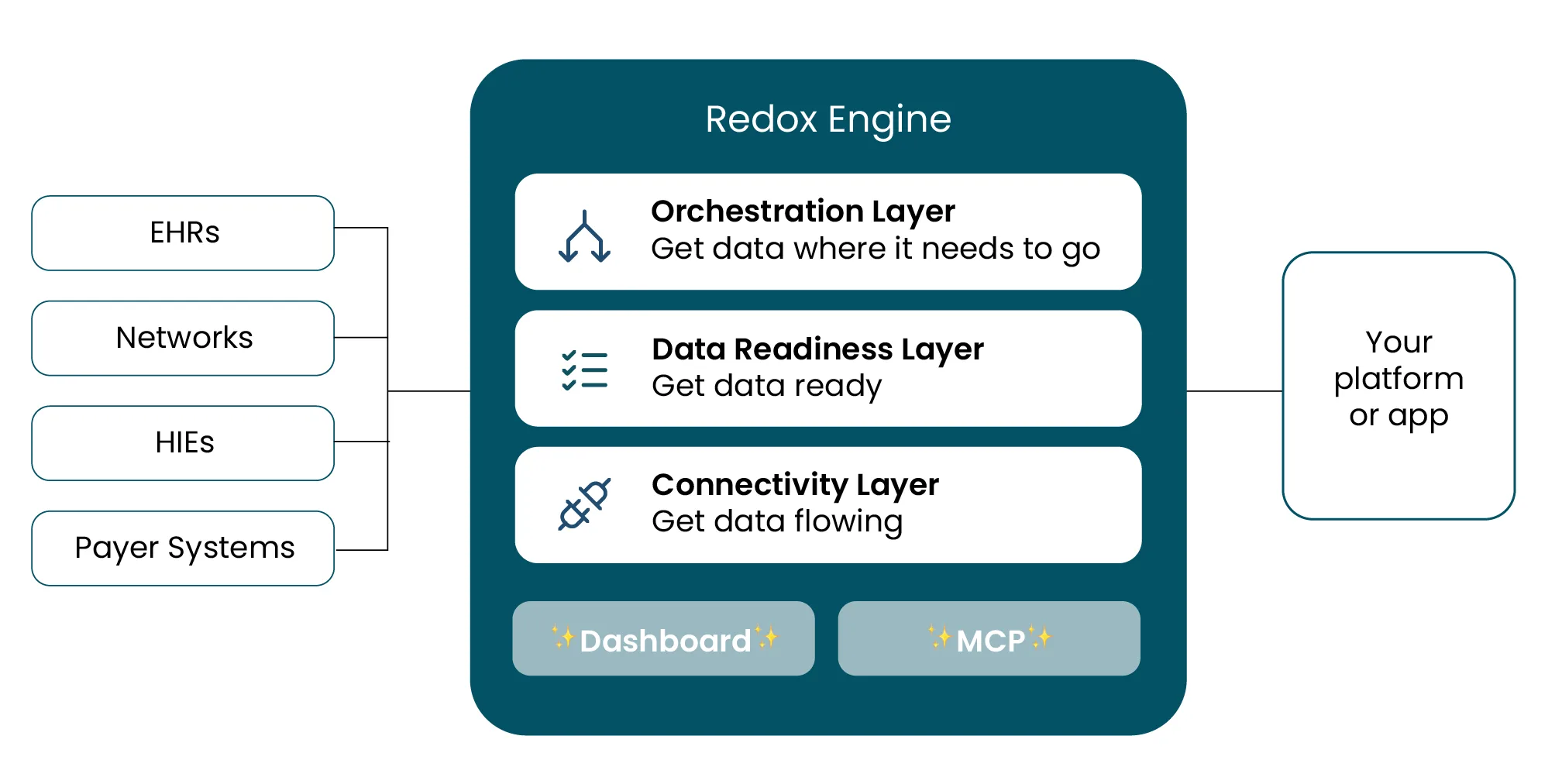
With Redox, you connect once. Your engineers write to a single reusable API, and Redox handles what sits behind it. That includes authentication, network connectivity, translation between formats, and monitoring. The differences across Epic, Oracle Health, and every other system stop being your roadmap and become ours.

Teams integrate up to 50% faster with Redox than building point-to-point connections in house.
Your application

Web app, device, EHR module, data warehouse, or AI agent

Redox

One API. Connect, translate, orchestrate, monitor

100+ EHRs and networks

Health systems, clinics, HIEs, payers, labs, pharmacies

Connect fast with one API

Go live on pre-built, reusable connectivity instead of an endless build, test, fix cycle. More than 30 authentication methods and 20 communication protocols. Redox owns VPN setup, monitoring, and maintenance, so your connectivity is zero-maintenance.

Prepare data in-flight

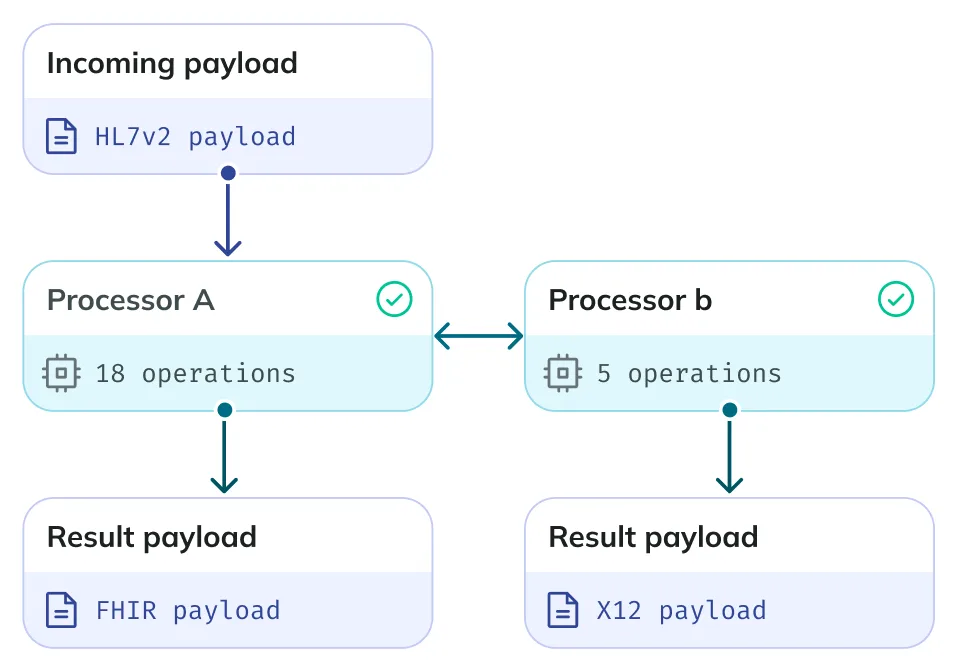
More than 9,000 reusable templates translate and normalize FHIR®, HL7® v2, CDA, NCPDP, X12, JSON, XML, CSV, and DICOM® into one consistent data model. With Redox Engine you can enrich records and standardize terminology before data reaches your application.

Activate data at scale

Build your EHR integration once and reuse it with every new health system. Trigger workflows from live clinical events, route data where it’s needed, and write discrete data back into the EHR so your product fits how clinicians already work.

What an EHR connection with Redox does

Redox connections are bidirectional. You read from the EHR and write discrete data back into it, in real time, in the order events happened. Redox Engine processes every event in strict first-in, first-out order, even during system outages, and handles bursts of up to 900 transactions per second.

Read from the EHR

  • Patient demographics and clinical history
  • Admissions, discharges, and transfers
  • Scheduling and appointment updates
  • Orders and referrals
  • Lab and diagnostic results
  • Medications and allergies
  • Vitals and flowsheet data
  • Imaging, notes, and clinical documents

Write back to the EHR

  • Vitals and remote device readings
  • Orders, referrals, and scheduled appointments
  • Diagnostic results
  • Notes and documents
  • Survey and assessment responses
  • Trend summaries for the care team

Discrete writeback, not a document drop. The data lands in the right field.

Launch inside the EHR

Embed your application directly in the provider workflow so clinicians never leave the chart to use your product.

Custom EHR APIs

Not every EHR follows the FHIR standard. When a system uses its own proprietary API, Redox can still connect to it, so you aren’t limited to the data a standard FHIR connection makes available.

More than 100 EHRs. Thousands of provider connections already live.

Redox maintains a library of pre-configured connections with thousands of healthcare providers, so your next customer is often a configuration rather than a project.

Explore

Explore Redox connections to providers, payers, EHRs, and HIEs/HINs

20 b+
healthcare data transactions in the past 12 months
109 B+
messages processed since 2014
99.95 %
uptime for seamless, uninterrupted data exchanges
14,900 +
live integrations
100 +
EHR connections
12,200 +
connected healthcare organizations from all corners of healthcare

Integrating with Epic

Epic integrations come with their own requirements for app review, security review, and workflow sign-off inside each health system. Redox maintains pre-configured Epic connections, and where a connection doesn’t exist yet, Redox’s team and templates shorten the build. Either way, your team isn’t starting from zero with every new customer.

Build EHR integrations in house, or use Redox

Most teams evaluating EHR integration software are really choosing between building it themselves and buying it. Here is the honest comparison between these EHR interoperability solutions:

Building point to point in house

Redox

Time to first integration

Months per health system, and the first one teaches you what you did not know.

Weeks. Up to 50% faster than building it yourself.

Every new customer

A new build, a new security review, a new negotiation.

Often an existing connection, or a repeatable process you already know.

Formats

Your engineers learn HL7v2, CDA, X12, NCPDP, and FHIR on the job.

More than 9,000 templates already built and refined across 14,000+ integrations.

Maintenance

Your on-call owns VPNs, interface changes, and every EHR upgrade.

Redox owns connectivity, monitoring, and maintenance.

Compliance

You build the controls and pay for the audits.

HITRUST certified, SOC 2 Type 2 report maintained.

Visibility

Whatever logging you had time to build.

Dashboard, interactive log views, alert handling, and 24/7 production support.

Who does the work

Your engineers, end to end.

Your choice: Redox fully manages it, or your team self-serves with Redox tooling.

See the shortest path to production

Tell us what you’re trying to connect.

Built for the volume healthcare actually runs at

2 B+
medical events processed monthly, in strict order
900
transactions per second at peak burst
2,100 +
reuseable configurations
85 %
of U.S. News top hospitals use at least one Redox-powered product

Security is at the core of the Redox platform

Certified

HITRUST® r2 certified across Redox cloud hosting environments, with a SOC 2® Type 2 report maintained and available on request. Compliant with HIPAA, GDPR, and CCPA.

Protected in motion

Advanced encryption protocols protect data at every stage of the integration.

Controlled

Role-based access control, dashboard single sign-on, and full audit visibility.

HITRUST i1 certified HITRUST r2 certified AICPA SOC 2 Type 2

HITRUST is a registered trademark of HITRUST Services Corp. SOC 2 is a registered trademark of the AICPA.

EHR integration questions, answered

Question
Answer

What is EHR integration?

EHR integration is the exchange of data between an electronic health record (EHR) system and another application, in one or both directions. It covers reading clinical data out of the EHR and writing new data back into it, and it depends on formats like HL7v2, FHIR, and CDA that can differ from system to system. Put simply, it’s how most healthcare applications connect to EHRs.

How long does an EHR integration take with Redox?

Weeks rather than quarters. Teams using Redox integrate up to 50% faster than building point-to-point connections in house, and Breg connected to major EHRs in 15 days.

Can Redox write data back into the EHR?

Yes. Redox electronic medical record integrations are bidirectional and support discrete writeback where the EHR allows it, so vitals, orders, results, notes, and survey responses land in the correct field rather than as an attached document.

Does Redox integrate with Epic?

Yes. Redox maintains pre-configured Epic connections and connects to 100+ EHRs in total, including Oracle Health (Cerner), athenahealth, MEDITECH, and eClinicalWorks. With Redox’s fully managed service, Redox also coordinates the EHR side of setup.

How is Redox different from other EHR integration vendors?

Many EHR interoperability solutions stop at the connection. Redox combines a platform you connect to once, pre-configured connections to 12,500+ healthcare systems and organizations, and a team that can fully manage your integrations or support your team as they self-serve, with 24/7 production support.

Can Redox help with EHR data migration?

Yes. Redox extracts data from legacy and sunsetting systems, translates it into modern formats, and loads it into the system or cloud repository where it needs to live.

What is an EHR adapter?

An EHR adapter translates between the format one system speaks and the format another expects. Redox includes HL7® v2 adapter support and a FHIR® sandbox, and normalizes every supported format into one data model so you build against a single interface.

Who uses Redox?

Health tech vendors, provider organizations, payers, EHR vendors, and life sciences companies. More than 12,200 healthcare organizations are connected.

Talk to an integration expert

Tell us what you are trying to connect and a Redoxer will follow up with the shortest path to production.